
Pirates en mer d’Arabie : L’Inde lance un commando héliporté et sauve 20 pêcheurs iraniens en 48h de traque
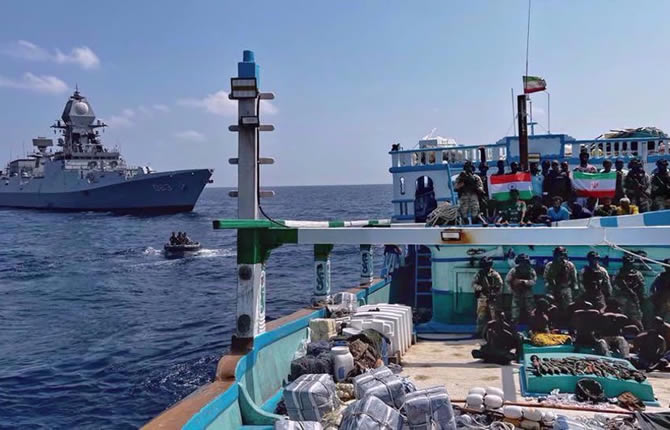
C’est une opération militaire qui fera date dans les annales de la lutte contre la piraterie maritime. En mer d’Arabie, au large de la côte nord-est de la Somalie, les forces armées indiennes ont arraché in extremis 20 membres d’équipage iraniens des griffes de pirates bien armés. Le chalutier Azini, transformé malgré lui en navire-mère pour les flibustiers, a été repris après plus de deux jours de traque acharnée. Un scénario digne d’un film d’action, mais bien réel.
Une traque de 48 heures, un commando venu du ciel
Tout commence le 29 octobre. Le navire de pêche iranien Azini est saisi au large des côtes somaliennes, entre Bandar Beyla et Xaafun, dans la région semi-autonome du Puntland. Selon les renseignements de la marine indienne, les pirates comptaient utiliser le chalutier comme « navire-mère » pour mener d’autres attaques en haute mer. Une menace directe pour la sécurité des voies maritimes.
Mais l’Inde ne l’entend pas de cette oreille. Dès la détection du bâtiment, un dispositif impressionnant est déployé : un navire de guerre, un hydravion de reconnaissance, et surtout, une unité commando héliportée, larguée depuis un avion de transport militaire C-17. Objectif : reprendre le Azini et libérer les otages. L’assaut final est donné le 2 novembre, à plus de 3 000 kilomètres de Mumbai. En 48 heures, la machine militaire indienne montre une coordination sans faille.
« Aucun pêcheur ni militaire indien n’a été blessé »
Le bilan est éloquent : les 20 membres d’équipage sont tous sains et saufs. Aucun mort, aucun blessé, ni parmi les pêcheurs iraniens, ni dans les rangs des soldats indiens. Une opération chirurgicale saluée par le ministre indien de la Défense, Rajnath Singh, qui n’a pas caché sa fierté sur le réseau X (ex-Twitter).
« Je félicite la marine indienne pour le succès de cette opération de 48 heures minutieusement coordonnée, qui a permis de libérer les 20 membres d’équipage du bateau de pêche Azini, capturé par des pirates. La détection rapide, l’interception et la libération en toute sécurité de l’équipage et du navire des mains de pirates bien armés, avec le soutien opportun de l’armée de l’air indienne, témoignent du haut niveau de préparation de la marine indienne », a-t-il déclaré.
Et d’ajouter : « L’Inde reste fermement attachée à la sécurité des voies maritimes ainsi qu’au maintien d’un espace libre, ouvert et protégé dans l’océan Indien. »
Un autre drame évité de justesse au large d’Oman
Cette opération réussie intervient dans un contexte de tension extrême en mer d’Arabie. Le même jour, un cargo indien, le MSV Al Jusufi, avec 14 marins à bord, a été touché par un « objet volant non identifié » au large d’Oman. Treize membres d’équipage ont pu être évacués sains et saufs par les garde-côtes omanais. Mais le bilan est plus sombre : un marin indien, Gandhar Nahim Ajij, originaire du Gujarat, a succombé à ses blessures. Le ministre indien des Ports, Sarbananda Sonowal, a exprimé sa « profonde douleur » et annoncé que les autorités indiennes à Oman sont mobilisées pour rapatrier le corps et venir en aide aux survivants.
Pendant ce temps, d’autres drames en série
La mer n’a pas fini de faire parler d’elle. Au Maroc, à Agadir, un couple de touristes britanniques a été retrouvé sans vie dans un hôtel de luxe. L’hypothèse d’une intoxication au gaz domestique est privilégiée par les autorités. Deux ressortissants français, également présents dans l’établissement, ont été gravement intoxiqués et transportés à l’hôpital. Une enquête a été ouverte sous la supervision du parquet.
Au Népal, c’est un accident aérien qui a coûté la vie à un ressortissant indien. Deux hélicoptères des compagnies Air Dynasty et Fishtail Air sont entrés en collision lors de l’atterrissage dans l’est du pays. Trois autres personnes ont été blessées, dont un Néo-Zélandais d’origine indienne, évacué par les airs. Les deux pilotes, légèrement touchés, ont été transportés à Katmandou. La cause de l’accident reste inconnue.
L’Inde, gendarme des mers ?
Au-delà du sauvetage spectaculaire du Azini, c’est un message fort que New Delhi envoie à la communauté internationale. Face à la recrudescence des attaques de pirates dans l’océan Indien, l’Inde se pose en garant de la sécurité maritime. Une démonstration de force qui pourrait bien redessiner les équilibres géopolitiques de la région. Mais pour l’heure, le plus important est ailleurs : vingt vies sauvées, et des familles iraniennes qui pourront enfin respirer.
Pirates in the Arabian Sea: India Launches Helicopter Commando Raid, Saves 20 Iranian Fishermen After 48-Hour Chase
It’s a military operation that will go down in the annals of the fight against maritime piracy. In the Arabian Sea, off the northeast coast of Somalia, Indian armed forces snatched 20 Iranian crew members from the clutches of heavily armed pirates. The trawler Azini, unwittingly transformed into a mother ship for the buccaneers, was recaptured after more than two days of relentless pursuit. A scenario worthy of an action movie, but very real.
A 48-hour chase, a commando from the sky
It all began on October 29. The Iranian fishing vessel Azini was seized off the Somali coast, between the coastal towns of Bandar Beyla and Xaafun, in the semi-autonomous Puntland region. According to Indian navy intelligence, the pirates intended to use the trawler as a "mother ship" to carry out further attacks on the high seas. A direct threat to the safety of maritime routes.
But India would have none of it. As soon as the vessel was detected, an impressive device was deployed: a warship, a reconnaissance seaplane, and above all, a helicopter-borne commando unit, dropped from a C-17 military transport aircraft. The objective: retake the Azini and free the hostages. The final assault was launched on November 2, more than 3,000 kilometers from Mumbai. In 48 hours, the Indian military machine demonstrated flawless coordination.
"No fishermen or Indian soldiers were injured"
The toll is eloquent: all 20 crew members are safe and sound. No deaths, no injuries, neither among the Iranian fishermen nor among the Indian soldiers. A surgical operation hailed by Indian Defense Minister Rajnath Singh, who did not hide his pride on X (formerly Twitter).
"I congratulate the Indian Navy for the success of this meticulously coordinated 48-hour operation, which led to the release of the 20 crew members of the fishing boat Azini, captured by pirates. The rapid detection, interception and safe release of the crew and the vessel from the hands of heavily armed pirates, with the timely support of the Indian Air Force, testify to the high level of preparedness of the Indian Navy," he said.
He added: "India remains firmly committed to the security of maritime routes and to maintaining a free, open and protected space in the Indian Ocean."
Another tragedy narrowly avoided off Oman
This successful operation comes amid extreme tension in the Arabian Sea. On the same day, an Indian cargo ship, the MSV Al Jusufi, with 14 sailors on board, was hit by an "unidentified flying object" off Oman. Thirteen crew members were evacuated safely by Omani coast guards. But the toll is darker: an Indian sailor, Gandhar Nahim Ajij, from Gujarat, succumbed to his injuries. Indian Ports Minister Sarbananda Sonowal expressed his "deep sorrow" and announced that Indian authorities in Oman are mobilized to repatriate the body and assist the survivors.
Meanwhile, a series of other tragedies
The sea is not done making headlines. In Morocco, in Agadir, a British couple was found dead in a luxury hotel. The hypothesis of domestic gas poisoning is favored by the authorities. Two French nationals, also staying in the establishment, were seriously poisoned and transported to hospital. An investigation has been opened under the supervision of the prosecutor's office.
In Nepal, an air accident claimed the life of an Indian national. Two helicopters from the companies Air Dynasty and Fishtail Air collided during landing in the east of the country. Three other people were injured, including a New Zealander of Indian origin, airlifted to hospital. The two pilots, slightly injured, were transported to Kathmandu. The cause of the accident remains unknown.
India, gendarme of the seas?
Beyond the spectacular rescue of the Azini, it is a strong message that New Delhi is sending to the international community. Faced with the resurgence of pirate attacks in the Indian Ocean, India is positioning itself as a guarantor of maritime security. A show of force that could well redraw the geopolitical balances of the region. But for now, the most important thing is elsewhere: twenty lives saved, and Iranian families who can finally breathe.
piraterie maritime, mer d’Arabie, marine indienne, sauvetage otages, chalutier iranien Azini, Somalie, commando héliporté, C-17, Rajnath Singh, sécurité maritime, océan Indien, attaque pirates, MSV Al Jusufi, Oman, intoxication gaz Agadir, collision hélicoptères Népal, actualité Cameroun, faits divers international
Christ Ndiffong (Stagiaire)
Le calendrier complet de la Can Féminine 2026
Suivez certains matchs en direct grâce à nos partenaires
Articles similaires
 Société
Élections de mi-mandat US : les Démocrates freinent sur une 3e destitution de Trump, l’Europe ne compte plus sur un « reset », et l’Amérique s’enfonce dans les crises
Mi-mandat 2026 : les Démocrates doutent d’une nouvelle destitution de Trump malgré une large...
 Société
Ormuz : Téhéran pose ses conditions, Washington frappe et négocie… le détroit s’embrase à nouveau
Reconnaissance de la souveraineté iranienne sur Ormuz, sanctions, frappes sur Qechm, 11 pétroliers...
 Société
Manifestations en France : Darmanin affiche une justice « extrêmement forte », les prisons, elles, débordent
Depuis le 17 octobre, 4 914 gardes à vue, 329 incarcérations. Les prisons françaises battent un...
 Société
Cyberattaques en Europe : des millions d’euros de nourriture détruits dans les supermarchés, pendant que les prix du gaz s’envolent
Une cyberattaque frappe des supermarchés dans au moins 7 pays européens et détruit des stocks...
 Société
RDC : les FARDC passent à l'offensive à Masisi, plusieurs villages secoués par de violents combats
RDC : les FARDC et les Wazalendo lancent une offensive à Masisi. Des combats éclatent à Mahanga,...
 Société
Cemac : la BEAC a injecté 265 millions de nouvelles pièces… et vos anciennes pièces sont désormais hors-jeu
La BEAC annonce 23 pièces par habitant dans la Cemac (contre 16 avant 2024) et vise 30 en 2030....