
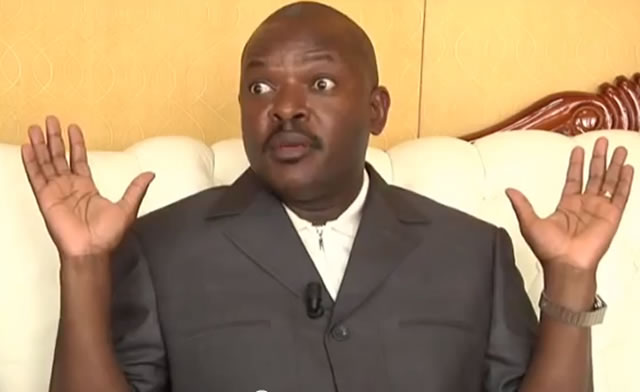
The political crisis, violence and security situation in Burundi continue to worsen despite different attempts to have the stakeholders negotiate and ultimately end the threatening resurgence of civil war in the country. Critics and keen observers of the evolution of the crisis largely blame government’s inflexibility for the current political impasse.
The new round of peace negotiations are expected to continue in the Tanzanian town of Arusha on Wednesday, January 6, 2016. The negotiations were re-launched in Kampala, Uganda on Monday, December 28, 2015 in a ceremony chaired by Ugandan President, Yoweri Museveni who is the mediator in the Burundian crisis designated by the East African Community.
The government delegation is not likely to participate in the Arusha peace talks. Burundi’s Foreign Affairs Minister, Alain Nyamitwe declared during the Kampala talks that government would not participate in the talks. He described the Arusha talks as an ambush on the Burundian government, stating his disapproval of the proposals of the mediator. According to Alain Nyamitwe, government was not closing all doors on the dialogue but merely rejecting the date of the talks that was imposed without consultations.
The Burundian government is not willing to have direct talks with the opposition that include members of the CNARED, a coalition that presents itself as upholding the Arusha peace agreement that ended more than a decade of civil war. They accuse President Pierre Nkurunziza of having have undermined the agreement. The government has reportedly refused to hold talks with CNARED, calling it a “terrorist organization.”
Government has accused the coalition of being behind a failed coup in May 2015, as well as ongoing attacks on security forces. Besides government officials, Nkurunziza’s ruling party leaders are opposed to dialogue with the opposition. Victor Burikukikiye an official of the party speaking ahead of the resumption of peace talks last week, was adamant on the fact that, “Those who participated in the coup attempt should not participate in the talks. Otherwise, you will not see us participate” Mail Online quoted.
The ongoing stand off between the Burundian government and the African Union on the issue of the deployment of 5,000 AU peacekeepers to Burundi, once more demonstrate government’s determination to uphold only its own ways of resolving the crisis. After the AU said it was ready to send the peacekeepers to tackle violence, Mr Nkurunziza on December 30, 2015 reacted with firm threats. “Everyone has to respect the borders of Burundi,” he said.
He further declared that, “In case they violate those principles, they would have attacked the country and every Burundian will stand up and fight against them.” He justified that, "When there are two warring forces then you can have a peacekeeping force. But this is not the case here, because we are facing a security problem. It is not a political issue, because this was resolved by the elections."
Le calendrier complet de la Can Féminine 2026
Suivez certains matchs en direct grâce à nos partenaires
Articles similaires
 Opinion
Maurice Kamto, Fogué, Bibou Nissack : le MRC accuse Times TV et exige des comptes devant la justice
La tension monte entre le MRC et certains acteurs du paysage audiovisuel camerounais. Le parti...
 Opinion
Ozanne, 12 ans, morte aux toilettes du Collège De La Salle : le père parle de sperme, la justice doit parler
Une élève de 12 ans meurt après un malaise aux toilettes du Collège catholique De La Salle à...
 Opinion
Ce chiffre qui dérange : le Cameroun compte plus de femmes que d'hommes
Au Cameroun, les femmes sont plus nombreuses que les hommes selon les derniers chiffres du BUCREP....
 Opinion
Médias et unité nationale : le MINDEF appelle la presse camerounaise à un sursaut éthique
Le Chef de Division de la Communication au MINDEF, le Capitaine de Vaisseau Atonfack Guemo, alerte...
 Opinion
Passeport camerounais 2026 : voici les 56 destinations accessibles sans complications
En 2026, le passeport camerounais donne accès à 56 destinations sans visa, avec visa à l'arrivée ou...
 Opinion
Souveraineté sanitaire au Sénégal : le vrai combat commence maintenant, entre financement, gouvernance et soins de qualité
Souveraineté sanitaire au Sénégal : le Dr Farba Lamine Sall propose trois leviers pour financer,...