L’Inde, en sa qualité de hôte, a réussi un pari majeur : fédérer un large consensus autour d’une IA « au service de l’humanité ». Alors que les puissances technologiques peinent souvent à s’entendre, cette adoption massive marque une étape cruciale. Le texte, bien que non contraignant, pose des fondations éthiques solides. Il insiste sur un partage équitable des bénéfices de l’IA, la souveraineté numérique des États et la nécessité de systèmes « sûrs, fiables et dignes de confiance ».
« Le déploiement à grande échelle de l’IA possède un potentiel sans précédent pour stimuler le développement économique et social », peut-on lire dans la déclaration. Pour les pays du Sud global, dont le Cameroun fait partie, cette précision est capitale. Elle ouvre la voie à un accès plus équitable aux infrastructures de recherche, souvent monopolisées par une poignée de nations industrialisées.
L’axe Brasilia-New Delhi au cœur de la recomposition
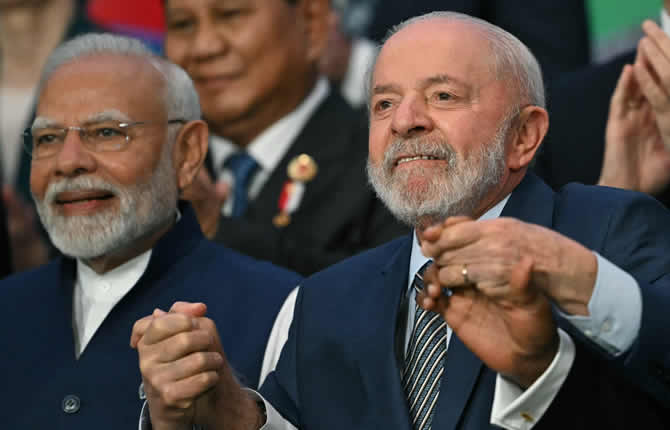
En marge du sommet technologique, la visite d’État du président brésilien Luiz Inacio Lula da Silva a offert un décorum propice aux grandes annonces géostratégiques. Accueilli par le Premier ministre indien Narendra Modi, Lula a été clair : le monde doit en finir avec la logique de la Guerre froide.
« Le Brésil veut commercer avec les États-Unis, avec la Chine, avec l’Inde, avec la Russie », a martelé Lula, défendant un multilatéralisme pragmatique. Une déclaration qui résonne comme une profession de foi pour les Brics, ce groupe de pays émergents dont l’influence ne cesse de croître. « La moitié de l’humanité participera aux activités des Brics », a-t-il rappelé, laissant entrevoir une refonte profonde des dynamiques commerciales internationales.
Un partenariat stratégique à 20 milliards de dollars
Mais au-delà des discours, ce sont des accords concrets qui ont scellé cette rencontre. Modi et Lula ont annoncé un renforcement spectaculaire de leur coopération dans des secteurs clés pour le 21ème siècle :
Minerais stratégiques et Défense : Un accord sur les minerais critiques et les terres rares a été signé pour sécuriser des chaîres d'approvisionnement résilientes, loin des tensions sino-américaines. La coopération militaire s’approfondit également, symbole d’une « confiance mutuelle » grandissante.
Objectif 20 milliards : Les deux géants visent un doublement de leurs échanges commerciaux pour atteindre 20 milliards de dollars dans les cinq proches années. L’Inde, premier partenaire du Brésil en Amérique latine, compte bien inonder le marché brésilien de produits pharmaceutiques abordables.
Souveraineté numérique : New Delhi va aider Brasilia à créer un « Centre d’excellence pour l’infrastructure publique numérique ». La coopération s’étendra aux supercalculateurs, aux semi-conducteurs et à la blockchain.
Pour les observateurs, ce rapprochement indo-brésilien est une pierre de plus dans l’édifice d’un monde multipolaire. Les deux pays, poids lourds de leurs régions respectives, partagent la même vision : celle d’un monde où le dialogue et la diplomatie priment sur la confrontation.
« Tous les problèmes doivent être résolus par le dialogue », a insisté Narendra Modi, avant de conclure sur une note d’avertissement unanime : « Le terrorisme et ses soutiens sont les ennemis de l’humanité tout entière. »
Alors que le Cameroun et l’Afrique centrale observent ces mutations, ces annonces posent une question cruciale : quelle place pour le continent dans cette nouvelle architecture technologique et commerciale ?
New Delhi Summit: 88 Nations Unite for Ethical AI, Lula and Modi Redraw Global Order
From February 18 to 19, New Delhi became the global hub for discussions on artificial intelligence. At the conclusion of the AI Impact Summit 2026, a diplomatic wave emerged: no fewer than 88 countries and international organizations endorsed the "Delhi Declaration." This sends a strong signal at a time when the technological race is further straining geopolitical balances.
India, as the host, achieved a major feat: building a broad consensus around an AI "for the benefit of humanity." While technological powers often struggle to find common ground, this widespread adoption marks a crucial step. Although non-binding, the text lays solid ethical foundations. It emphasizes the equitable sharing of AI's benefits, the digital sovereignty of states, and the need for "safe, reliable, and trustworthy" systems.
"The large-scale deployment of AI and its applications has unprecedented potential to boost economic and social development," the declaration states. For countries of the Global South, this precision is critical. It paves the way for more equitable access to research infrastructure, often monopolized by a handful of industrialized nations.
The Brasilia-New Delhi Axis at the Heart of Reshaping
On the sidelines of the technology summit, the state visit by Brazilian President Luiz Inacio Lula da Silva provided a fitting backdrop for major geostrategic announcements. Welcomed by Indian Prime Minister Narendra Modi, Lula was clear: the world must move beyond the Cold War logic.
"Brazil wants to trade with the United States, with China, with India, with Russia," Lula asserted, defending a pragmatic multilateralism. This statement resonates as a testament of faith for the BRICS, a group of emerging countries whose influence continues to grow. "Half of humanity will participate in BRICS activities," he reminded, hinting at a profound reshaping of international trade dynamics.
A $20 Billion Strategic Partnership
Beyond the speeches, concrete agreements cemented this meeting. Modi and Lula announced a dramatic strengthening of their cooperation in key sectors for the 21st century:
Strategic Minerals and Defense: An agreement on critical minerals and rare earths was signed to secure resilient supply chains, far from Sino-American tensions. Military cooperation is also deepening, a symbol of growing "mutual trust."
The $20 Billion Goal: The two giants aim to double their bilateral trade to reach $20 billion within the next five years. India, Brazil's top partner in Latin America, plans to flood the Brazilian market with affordable pharmaceutical products.
Digital Sovereignty: New Delhi will help Brasilia create a "Center of Excellence for Digital Public Infrastructure." Cooperation will extend to supercomputers, semiconductors, and blockchain.
For observers, this Indo-Brazilian rapprochement is another building block in the construction of a multipolar world. Both countries, heavyweights in their respective regions, share the same vision: a world where dialogue and diplomacy prevail over confrontation.
"All problems must be resolved through dialogue and diplomacy," insisted Narendra Modi, before concluding with a unanimous warning: "Terrorism and its supporters are the enemies of all humanity."
As Cameroon and Central Africa observe these shifts, these announcements raise a crucial question: what place for the continent in this new technological and commercial architecture?
Sommet de New Delhi 2026, Déclaration de Delhi, Intelligence Artificielle, IA éthique, coopération internationale, Narendra Modi, Lula da Silva, Brésil Inde partenariat, Brics, minerais stratégiques, souveraineté numérique, gouvernance mondiale, AI Impact Summit, géopolitique, Cameroun, Afrique, Sud global, nouvelles technologies, multilatéralisme, accord commercial Inde Mercosur.
Silognhia Edwige (Stagiaire)