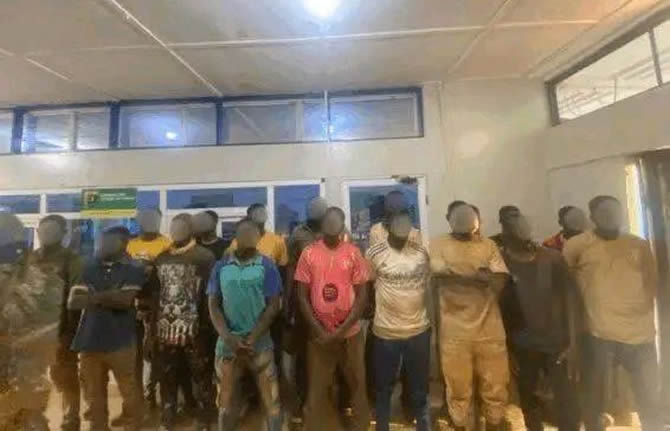
Selon les détails de l’enquête, les soldats burkinabés ont été surpris en train d’aménager activement une position de combat, utilisant des sacs de sable pour fortifier leur emplacement. Cette activité militaire sur un sol étranger a immédiatement déclenché l’intervention des forces ghanéennes. L’opération a conduit non seulement à la capture des hommes, mais aussi à la saisie d’un arsenal comprenant des armes et des engins explosifs improvisés (EEI).
La version avancée par les militaires interpellés lors de leur interrogatoire ? Un simple égarement. Une explication qui peine à convaincre les autorités ghanéennes face à la matérialité des faits : une fortification en cours et des armes en quantité. Face à la gravité potentielle de l’acte, le commandement militaire ghanéen a opté pour une réponse ferme mais protocolaire : les 17 soldats ont été remis aux services de l’immigration du Ghana en vue de leur expulsion.
Cet épisode survient dans un climat bilatéral particulièrement dégradé. Le Ghana et le Burkina Faso s’accusent mutuellement depuis des mois de déstabiliser leurs zones frontalières respectives, théâtres d’une insécurité endémique liée à l’expansion de groupes jihadistes. Chaque côté reproche à l’autre des incursions, des soutiens tacites à des éléments troublant l’ordre, ou une gestion laxiste de la frontière poreuse.
L’arrestation de ces soldats, loin d’apaiser les craintes, risque d’attiser les suspicions. S’agit-il d’une bavure tragique, d’une mission non autorisée ou du symptôme d’une escalade plus inquiétante ? Les capitales, Accra et Ouagadougou, devront maintenant gérer cette crise avec doigté pour éviter qu’un incident local ne dégénère en conflit diplomatique ouvert. Les sables de la frontière sont décidément mouvants.
Shifting Sands at the Border: 17 Burkinabe Soldiers Arrested in Ghana While "Building" Offensive Position
In a context of rising border tensions, a rather unusual incident has shaken the region. This Thursday, Ghanaian security forces arrested a group of 17 soldiers from Burkina Faso, Ghana's northern neighbour. The information, first reported by Ghanaian radio station Asempra 94.7 FM, highlights the fragility of relations between the two countries.
According to investigation details, the Burkinabe soldiers were caught actively setting up a combat position, using sandbags to fortify their location. This military activity on foreign soil immediately triggered the intervention of Ghanaian forces. The operation led not only to the capture of the men but also to the seizure of an arsenal including weapons and improvised explosive devices (IEDs).
The version given by the apprehended soldiers during their interrogation? A simple case of getting lost. An explanation that struggles to convince Ghanaian authorities given the material evidence: an ongoing fortification and a quantity of weapons. Faced with the potential seriousness of the act, the Ghanaian military command opted for a firm but procedural response: the 17 soldiers were handed over to Ghana's immigration services for deportation.
This episode occurs in a particularly degraded bilateral climate. For months, Ghana and Burkina Faso have been accusing each other of destabilizing their respective border areas, which are theatres of endemic insecurity linked to the expansion of jihadist groups. Each side accuses the other of incursions, tacit support for elements disturbing the peace, or lax management of the porous border.
The arrest of these soldiers, far from alleviating fears, risks fueling suspicions. Is this a tragic blunder, an unauthorised mission, or a symptom of a more worrying escalation? The capitals, Accra and Ouagadougou, will now have to manage this crisis with tact to prevent a local incident from degenerating into an open diplomatic conflict. The sands of the border are decidedly shifting.
Ghana, Burkina Faso, soldats arrêtés, incident frontalier, tension diplomatique, sécurité frontalière, Afrique de l'Ouest, Asempra FM, engins explosifs, position de combat, sacs de sable, immigration, expulsion, relations internationales, Sahel, jihadisme, Accra, Ouagadougou, forces armées, géopolitique
Moussa Nassourou