
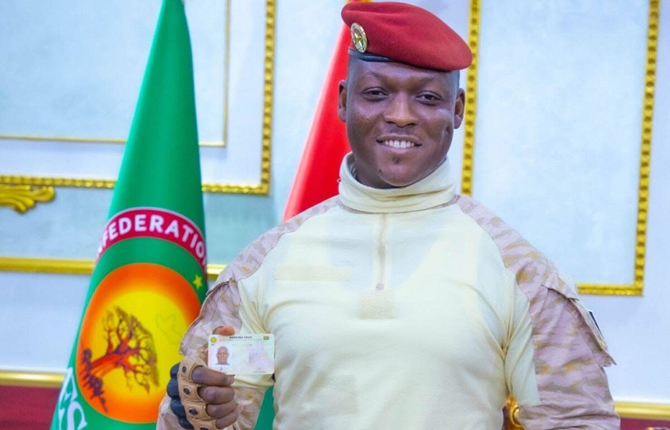
Le ministre burkinabè de la Sécurité a personnellement remis le précieux sésame au chef de l’État. Ce document nouvelle génération, présenté comme un outil de souveraineté technologique, intègre des dispositifs de sécurité avancés. Il a pour vocation de garantir une identification infaillible des citoyens tout en protégeant rigoureusement leurs données personnelles, un enjeu crucial à l'ère du numérique.
Derrière ce geste administratif se dessine une ambition géopolitique d'envergure. L’introduction d’une pièce d’identité commune aux trois pays membres de l’AES – le Burkina Faso, le Mali et le Niger – est une pierre angulaire de leur projet d’approfondissement des liens. L'objectif est clair : renforcer l'autorité, la cohésion et la portée du jeune bloc sahélo-saharien.
Cette initiative est aussi, et peut-être surtout, lue comme une affirmation d’autonomie. Alors que la Communauté économique des États de l’Afrique de l’Ouest (Cédéao) déploie depuis des années sa propre carte facilitant la libre circulation, l'AES choisit de tracer sa propre voie. En créant son propre standard d'identification, l'Alliance concrétise sa volonté de s'affranchir des cadres institutionnels hérités et d'accélérer la construction d'un destin commun, en dehors des sentiers battus.
La remise de cette carte au président Traoré n'est donc pas un simple fait divers. C'est l'acte fondateur d'une nouvelle identité partagée, un symbole tangible de la marche résolue du Burkina, du Mali et du Niger vers une intégration chaque jour plus étroite.
Sahelian Integration: President Traoré Ushers in the Era of the AES Biometric ID Card
In a highly symbolic move, Captain Ibrahim Traoré, President of Burkina Faso's Transition, has become the very first citizen to receive the new biometric identity card of the Alliance of Sahel States (AES). This ceremony, reported by Africanews, marks a concrete step towards regional integration and sends a strong political message to the historical partners in the sub-region.
The Burkinabè Minister of Security personally handed the precious document to the head of state. This new-generation ID, presented as a tool of technological sovereignty, incorporates advanced security features. It is designed to guarantee foolproof citizen identification while rigorously protecting personal data, a crucial issue in the digital age.
Behind this administrative act lies a sweeping geopolitical ambition. The introduction of a common identity document for the three AES member states – Burkina Faso, Mali, and Niger – is a cornerstone of their project to deepen ties. The goal is clear: to strengthen the authority, cohesion, and reach of the young Sahelo-Saharan bloc.
This initiative is also, and perhaps primarily, seen as an assertion of autonomy. While the Economic Community of West African States (ECOWAS) has been deploying its own card facilitating free movement for years, the AES is choosing to chart its own course. By creating its own identification standard, the Alliance is materializing its desire to break free from inherited institutional frameworks and accelerate the construction of a common destiny, off the beaten path.
Presenting this card to President Traoré is therefore not mere routine news. It is the founding act of a new shared identity, a tangible symbol of the resolute march of Burkina, Mali, and Niger towards ever-closer integration.
AES, Alliance des États du Sahel, Ibrahim Traoré, Burkina Faso, carte d'identité biométrique, intégration régionale, Sahel, Mali, Niger, Cédéao, souveraineté, données personnelles, sécurité, identité numérique, libre circulation, Afrique de l'Ouest, géopolitique africaine
Moussa Nassourou