L’hôtel Platinium de Bonanjo, à Douala, s’est transformé cette semaine en véritable épicentre intellectuel et spirituel du Cameroun. Les 6 et 7 mai 2026, le Theosis Higher Institute y a réuni certains des plus éminents théologiens, universitaires, chefs traditionnels et responsables religieux du pays à l’occasion du Symposium théologique 2026 sur l’ecclésiologie et l’anthropologie culturelle.
Placée sous le thème : « L’Église et la Nation : comprendre notre passé, construire notre avenir », cette rencontre de deux jours a été présentée par les organisateurs comme un moment national de réflexion, de dialogue et d’enseignement théologique.
Des participants issus de plusieurs confessions religieuses, milieux académiques et traditions culturelles ont répondu présents, donnant à l’événement une dimension à la fois solennelle et fédératrice.
« Comme va l’Église, ainsi vont les nations »
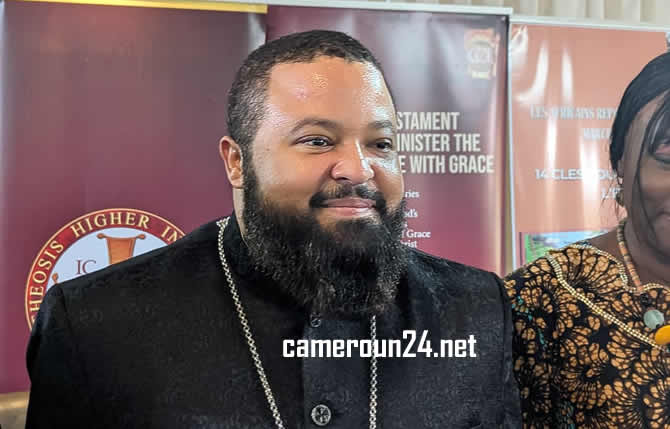
Le ton du symposium a été donné dès l’ouverture par le professeur Shawn Smith, chargé de la leçon inaugurale consacrée à la portée du thème retenu.
Pour lui, la rencontre allait bien au-delà d’un simple exercice académique. Fidèle à sa conviction selon laquelle « comme va l’Église, ainsi vont les nations », le théologien a placé chaque échange sous le sceau de la responsabilité spirituelle et sociétale.
S’exprimant après la cérémonie de clôture, il a salué une mobilisation au-delà des attentes.
« Nous ne sommes pas venus parler de l’Église de loin. Nous sommes venus être l’Église, réfléchir, débattre et construire ensemble. Ce qui s’est produit ici pendant deux jours résonnera bien au-delà de ces murs », a déclaré le Pr Shawn Smith.
Une rencontre entre réflexion théologique et identité africaine
La présidente du comité d’organisation, Dr Annie Smith, a ouvert les travaux avec émotion, évoquant l’aboutissement d’une vision longtemps portée.
« Nous avions prié pour un rassemblement à la fois crédible sur le plan académique et transformateur sur le plan spirituel. Dieu a répondu à cette prière », a-t-elle affirmé.
Le symposium a été structuré autour de quatre grands panels et de plusieurs communications majeures.
Le Pr Jean-Paul Messina, historien de l’Église et enseignant à l’Université Catholique d’Afrique Centrale, a apporté une profondeur historique aux débats.
« L’Église en Afrique n’est pas arrivée comme une étrangère. Elle est arrivée comme une semence. Comprendre cette semence permet de comprendre tout ce qui a grandi depuis », a-t-il expliqué.
Même tonalité chez le Révérend Professeur Charles Elom Nanga, spécialiste du luthéranisme et de l’anthropologie culturelle africaine.
« La culture n’est pas l’ennemie de l’Évangile. Elle est la langue à travers laquelle l’Évangile parle. Quand nous faisons taire la culture, nous faisons taire une partie de la voix de Dieu », a-t-il soutenu.
L’Église face à la question de l’identité africaine
Monseigneur Robert Ondoa a livré l’une des interventions les plus marquantes du symposium autour du thème : « Ecclésiologie et anthropologie culturelle : la problématique de l’être et du non-être selon Jean 17:11 et 16 ».
« L’Église doit affronter la question de l’identité. Être dans le monde sans être du monde n’est pas une contradiction. C’est notre vocation. Et l’Afrique doit définir elle-même ce que cela signifie », a-t-il déclaré.
Le prince Alexandre Kum’a Ndumbè III, historien et héritier du trône de Lock Priso, a quant à lui relié la réflexion théologique à la mémoire culturelle africaine.
« On ne peut pas construire l’avenir de l’Église en Afrique en ignorant ce que l’Afrique garde en mémoire. La mémoire n’est pas de la nostalgie. Elle est le fondement de l’identité », a-t-il martelé.
Les traditions africaines au cœur du débat
Le patriarche Papa Mbombock Malet Ma Njami Mal Njam, figure de l’institution traditionnelle Bassaa Mbok et conseiller culturel auprès de l’UNESCO, a insisté sur l’héritage spirituel africain.
« Nos ancêtres connaissaient Dieu avant l’arrivée des missionnaires. La mission de l’Église aujourd’hui n’est pas de remplacer cette connaissance, mais de l’accomplir », a-t-il lancé devant une assistance attentive.
Même approche pour le patriarche Étienne Valère Epée, gardien des traditions sawa.
« L’Évangile a pris racine en Afrique non pas malgré notre culture, mais à travers elle. Chaque langue, chaque tradition et chaque rituel porte une vérité que la théologie continue encore d’explorer », a-t-il déclaré.
Femmes, unité chrétienne et transformation nationale
Les questions sociales et communautaires ont également occupé une place centrale.
La Révérende Pasteure Claire Iguette Onobion, psychosociologue et théologienne, a appelé l’Église à mieux accueillir les réalités humaines des fidèles.
« Lorsqu’une femme entre dans une communauté de foi, elle apporte toute son histoire, ses blessures, sa culture et son identité. L’Église doit apprendre à recevoir cela pleinement », a-t-elle souligné.
La professeure Wogaing Jeannette, spécialiste des études de genre et de l’anthropologie culturelle, a dénoncé l’absence des femmes dans certains débats ecclésiaux.
« Nous parlons constamment de l’Église et de la nation sans parler des femmes. Pourtant, les femmes sont l’Église. Les femmes sont la nation », a-t-elle affirmé.
Sur le plan de l’unité chrétienne, le Révérend Robert Goyek Daga, président du Programme des relations islamo-chrétiennes en Afrique, a salué la diversité confessionnelle réunie à Douala.
« Catholiques, protestants, luthériens, baptistes, orthodoxes et évangéliques ont passé deux jours ensemble dans l’unité. Ce n’est pas anodin. C’est un modèle pour le Cameroun », a-t-il déclaré.
« Le Cameroun a besoin de guérison »
Le Révérend Dr Jean Libom Li Likeng, président de l’Association des Évangéliques en Afrique, a livré l’un des messages les plus forts de la clôture.
« Le Cameroun a besoin de guérison : guérison politique, sociale et spirituelle. L’Église possède les outils. Ce symposium nous a rappelé que nous avons aussi le mandat. Il nous faut désormais le courage », a-t-il affirmé.
En conclusion des travaux, le professeur Shawn Smith a insisté sur la portée historique de cette rencontre.
Pour les participants, le symposium n’était pas une simple conférence, mais un véritable rendez-vous spirituel destiné à repositionner l’Église comme acteur majeur du changement culturel, de la transformation sociale et du développement des nations africaines.
La soirée de clôture s’est achevée par un cocktail dînatoire et la dédicace officielle des actes du Symposium 2025, marquant la transition entre les réflexions précédentes sur la christologie et les nouveaux questionnements autour de l’identité, de la mission et de la place de l’Église dans les sociétés africaines.
Une interrogation demeure désormais au cœur du débat : l’Église au Cameroun joue-t-elle réellement son rôle de moteur de transformation nationale, ou est-il temps d’ouvrir une profonde remise en question ?
THEOLOGIANS, SCHOLARS, AND CHURCH LEADERS CONVERGE IN DOUALA TO DEFINE THE CHURCH'S ROLE IN AFRICA'S FUTURE.
Douala's Hotel Platinium in Bonanjo became the intellectual and spiritual heartbeat of Cameroon this week as Theosis Higher Institute brought together some of the nation's most distinguished theologians, academics, traditional leaders, and church figures for its 2026 Theological Symposium on Ecclesiology and Cultural Anthropology, held May 6 and 7 under the theme: "The Church and the Nation: Understanding Our Past, Building Our Future."
The two-day gathering, described by organisers as a nationwide moment of learning, dialogue, and theological reflection, drew participants from across denominational, academic, and cultural lines, a rare convergence that gave the event both its weight and its warmth.
Setting the tone for the entire symposium, Prof. Shawn Smith delivered the inaugural lesson on the significance of the symposium theme. For Prof. Smith, the gathering was never merely academic. As he has consistently stated, "As the Church goes, so go the nations", a conviction that framed every session of the two-day event.
Speaking to reporters after the closing ceremony, Prof. Smith said the response from participants exceeded all expectations. "We did not come here to talk about the Church from a distance. We came to be the Church, thinking, debating, and building together. What happened in this room over two days will echo far beyond these walls."
Dr. Annie Smith, President of the Organising Committee, delivered the welcome address on Day 1. Visibly moved by the turnout and the quality of engagement, she described the symposium as a fulfillment of a long-held vision. "When we planned this, we prayed for a gathering that would be both academically credible and spiritually transformative. God answered that prayer. This was both."
The symposium featured four major panels and two key presentations, each drawing from a deep well of expertise.
Prof. Jean-Paul Messina, Professor of Church History and Religious Studies at the Université Catholique d'Afrique Centrale and consultant to the Dicastery for Interreligious Dialogue, delivered a major presentation on Day 2. His contribution gave the symposium its historical depth. Reflecting on his presentation afterwards, Prof. Messina noted, "The Church in Africa did not arrive as a stranger. She arrived as a seed, and understanding that seed is how we understand everything that has grown since."
Rev. Prof. Charles Elom Nanga, one of Africa's leading experts in Lutheranism and African cultural anthropology, followed with a presentation rooted in decades of fieldwork. "Culture is not the enemy of the Gospel," he told delegates. "Culture is the language through which the Gospel speaks. When we silence culture, we silence part of God's voice."
Monseigneur Robert Ondoa brought one of the most intellectually charged contributions, a reflection on "Ecclesiology and Cultural Anthropology: The Problematic of Being and Non-Being According to John 17:11 & 16." After his presentation, he told attendees, "The Church must wrestle with the question of identity. In the world, but not of it, this is not a contradiction. It is our calling. And Africa must define what that looks like on her own terms."
His Royal Highness Prince Alexandre Kum'a Ndumbè III, historian, political scientist, and heir to the throne of Lock Priso, linked theological reflection to the deeper question of African identity and cultural memory. "You cannot build the future of the Church in Africa while ignoring what Africa remembers," he said pointedly. "Memory is not nostalgia. Memory is the foundation of identity."
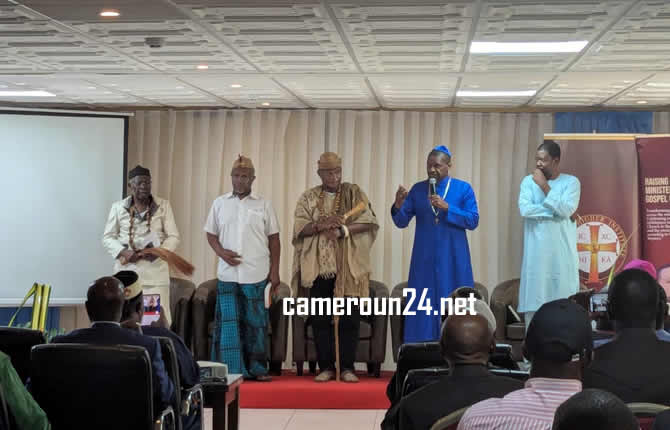
Papa Mbombock Malet Ma Njami Mal Njam, Patriarch of the Bassaa traditional institution Mbok and UNESCO cultural advisor, enriched Panel 1 with the weight of ancestral wisdom. "Our elders knew God before the missionaries came," he told a visibly attentive audience. "The task of the Church today is not to replace that knowledge, it is to fulfil it."
Patriarch Etienne Valère Epée, linguist and guardian of Sawa traditions, was equally direct. "The Gospel took root in Africa not in spite of our culture, but through it. Every language, every tradition, every ritual carries a truth that theology is still catching up with."
Dr. Georges Boum, expert in Christian communications and symposium moderator, summed up Day 1 with characteristic energy. "What I witnessed today was not just a symposium. It was a reckoning, the Church looking at itself honestly and asking hard questions. And that is exactly what this nation needs."
Rev. Pastor Claire Iguette Onobion, psychosociologist and theologian, reflected on her contribution with quiet conviction. "When a woman walks into a faith community, she brings her whole history, her wounds, her culture, her identity. The Church must learn to receive that fully, or it will keep losing the very people it is called to serve."
Rev. Dr. Théophile Obaker, Socio-anthropologist of religions and expert in Cameroon's revival church history, did not mince words in his reaction. "The revival church in Cameroon changed lives. But revival without theology becomes emotion without direction. This symposium is a call to anchor our fire in truth."
Prof. Wogaing Jeannette, renowned scholar in cultural anthropology and gender studies, brought a perspective that resonated strongly with many in the room. "We keep talking about the Church and the nation without talking about women. But women are the Church. Women are the nation. Until that is acknowledged at every level, our conversations remain incomplete."
Rev. Dr. Jacques Duclair SAP, whose presentation on discipleship and orality drew sustained applause, said afterwards, "Africa's greatest theological resource is not in our libraries. It is in the mouths of our grandmothers and the memories of our villages. The Church that learns to listen to that will transform a continent."
Abbé Nkala Daniel Anatole, Roman Catholic priest and author, spoke with pastoral simplicity. "I came here from a parish 35 kilometres from Ntui. I serve people who are invisible to the nation. This symposium reminded me that the Church's greatest work is always done in the margins."
Reverend Robert Goyek Daga, Chairman of the Programme for Christian-Muslim Relations in Africa, offered a message of unity that cut across denominational lines. "We spent two days together , Catholics, Protestants, Lutherans, Baptists, Orthodox, Evangelicals. And we were one. That is not nothing. That is a miracle. And it is a model for what Cameroon can be."
Rev. Prof. David Mbengu, General Secretary of the Council of Protestant Churches of Cameroon, echoed that sentiment. "Theology must produce unity, or it has failed. What gave me hope at this symposium is that the brightest minds in our Church are no longer content to talk past each other. They are listening. And that changes everything."
Rev. Prof. Charles Elom Nnanga, Dean of the Faculty of Theology at the Protestant University of Central Africa, reflected on the symposium's academic legacy. "We will look back at this gathering as a turning point, the moment the Church in Cameroon decided to think seriously about who she is and who she is called to become."
Reverend Pastor Edoube Ernest, President General of the Union des Églises Baptistes du Cameroun, was direct. "The Baptist church has always believed that the Gospel is for every person, every community, every nation. What this symposium confirmed is that the Gospel is also for every conversation, including the hard ones."
Prof. Joseph N. Mfonyam, Bible translator and missionary with Wycliffe Bible Translators since 1981, closed with a reflection born of four decades in the field. "I have translated the Word of God into languages the world has never heard of. And in every one of those languages, the Gospel was already waiting. It just needed a vessel. The Church is that vessel."
Rev. Dr. Jean Libom Li Likeng, President of the Association of Evangelicals in Africa, was among the last to speak to journalists. "Cameroon is a nation in need of healing, political healing, social healing, spiritual healing. The Church has the tools. This symposium reminded us that we also have the mandate. Now we must have the courage."
When Prof. Shawn Smith took the floor for the symposium's closing remarks on Day 2, the message was clear: this was not merely a conference. It was a divine appointment. The Church, the gathering concluded, is not a relic of the past, it is the primary agent of cultural change, social transformation, and national advancement in Africa. And the nations rise or fall with it.
The evening closed with a dinner cocktail and the official dedication of the 2025 Symposium Proceedings, a symbolic passing of the baton from last year's reflection on Christology to this year's deeper interrogation of the Church's identity, mission, and place in African society.
With some of Africa's sharpest theological and cultural minds now on record, is the Church in Cameroon truly living up to its calling as an agent of national transformation, or is it time for a reckoning? That is the question, the symposium answered.
Douala, Église Cameroun, symposium théologique 2026, Theosis Higher Institute, religion Cameroun, théologiens africains, Église et nation, anthropologie culturelle, Shawn Smith, Jean Paul Messina, Robert Ondoa, Alexandre Kum'a Ndumbè III, christianisme Afrique, leaders religieux Cameroun, transformation nationale, culture africaine, Église africaine, Bonanjo Douala, actualité religieuse Cameroun, société Cameroun
William Ndi